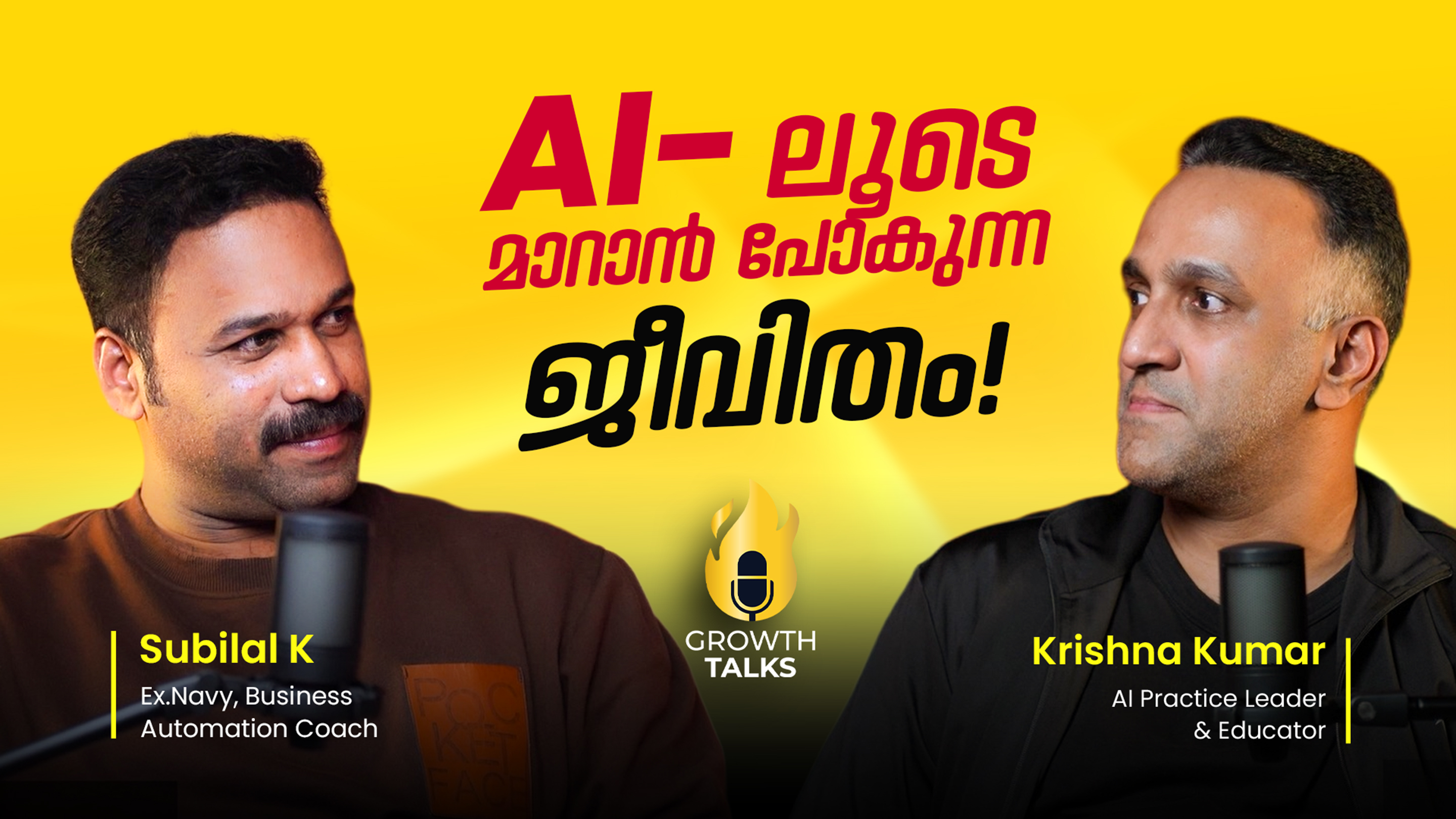
The Life That’s Going to Change Through AI- Krishna Kumar
The Life That’s Going to Change Through AI- Krishna Kumar
The episode opens with an introduction to KK, a digital transformation and business growth consultant from Kerala, specializing in AI and generative AI.KK shares his journey with AI starting around 2019, notably with early tools like Copy.ai and later with ChatGPT 3.5 in December 2022, marking a pivotal moment in recognizing AI’s unique potential.
Key insight;
Early AI interactions felt different due to human-like conversational capabilities, signaling real intelligence rather than static programmed responses.
He emphasizes the continuous improvement of AI models with regular updates and new features, highlighting the dynamic nature of AI technology.
Since January 2023, KK has conducted over 150 workshops reaching 30,000+ learners, including governments, corporates, startups, and edtech platforms, positioning himself primarily as an AI educator.
He categorizes the audience into three groups:
10% are advanced users experimenting actively with AI.
60-70% have superficial knowledge, wanting to learn more.
A portion remains skeptical, harboring fears or misunderstandings about AI.
Teaching approach: Demonstrate AI’s practical "magic" through tools and use cases that save time and effort, rather than relying solely on theory.
KK stresses the importance of continuously learning and engaging with AI to keep pace with rapid advancements.He shares a personal anecdote about embracing learning in his 40s by “throwing himself into the fire,” underlining the need for hands-on experience to truly master AI.
The rapid growth of AI users is noted: within a year, ChatGPT has amassed around 800 million users—a massive market shift from concept to mainstream adoption.
[00:10:55 → 00:24:43]
AI as a Personalized, Learning Companion
Discussion on AI’s ability to personalize interactions, with AI “knowing” user preferences and continuously learning from conversations, creating a mirror or super-intelligent friend.
AI combines:
Unsupervised learning: AI models learn from massive, unstructured data (movies, environment, online content).
Supervised learning: Human feedback and structured training guide AI outputs.
Reinforcement learning with human feedback: Billions of daily interactions help AI self-improve exponentially.The scale of data creation is unprecedented: 95% of the internet’s data was produced between 2015 and 2025, fueling AI training.This vast, freely available data combined with powerful GPUs and cloud distribution has enabled the rapid evolution of AI capabilities.
KK shares a futuristic scenario: AI could become a “digital avatar” or “immortalized” knowledge source of a person, accessible to their descendants with personalized voice and memory, acting as an ultimate mentor or guide.This concept is linked to the idea of AI avatars replicating iconic personalities such as Steve Jobs or Aristotle, enabling users to receive advice or responses in their style.
Example: The “Fiesta” app allows users to interact with AI versions of historical figures like Mahatma Gandhi, demonstrating early practical applications of personalized AI personas.
AI tutors are highlighted as more effective than traditional Ivy League professors due to their vast, interdisciplinary knowledge, personalized learning styles, and instant availability.
Education is rapidly transforming with AI integration; students and teachers benefit as AI takes over tutoring and repetitive tasks, freeing educators for inspiration and mentorship roles.
[00:24:44 → 00:36:14]
AI’s Impact on Knowledge Work and Prompting
AI is revolutionizing knowledge work by automating time-consuming cognitive tasks: summarizing documents, creating presentations, analyzing data, and coding.
Coders evolve from line-by-line programmers to architects designing complex systems, enabled by AI assistance.AI also enhances writing skills, turning average writers into good ones and good writers into great ones—though foundational skills remain essential to verify AI outputs.
Prompt engineering emerges as a critical skill:
95% of users employ basic or average prompts, leading to suboptimal results.
Only 5% master advanced prompting techniques (mega prompts, system prompts) that unlock AI’s full potential.Investing a few minutes in crafting detailed prompts can yield outputs equivalent to a day’s work, offering massive efficiency gains.Prompting is described as learning a new language—knowing how to communicate with AI to get precise, valuable outputs.Users who monetize AI outputs are those who understand this prompting language deeply. KK stresses the importance of strategic prompting over casual curiosity-driven use to generate economic value and career growth.
[00:36:15 → 00:48:36]
The Future of Prompting, AI Agents, and Democratization
Despite AI’s integration into many tools, prompting remains essential for building serious AI applications, voice agents, and custom models.Many users dislike prompt writing because it requires effort and clarity, but voice-to-text prompting tools (like Jajibri) can simplify this by allowing users to explain problems conversationally.
AI’s ability to generate tailored proposals or reports based on detailed context (e.g., CEO preferences, constraints) demonstrates how context-rich prompting yields 10x better results with 1/10th effort
The discussion includes a shift in mindset: valuing strategic laziness or leverage—finding shortcuts with AI rather than relying solely on hard work to achieve disproportionate results.
There's a cultural challenge, as society often stigmatizes leverage and shortcuts as cheating, while in reality, leveraging AI should be celebrated as smart work.
KK presents a proprietary framework for identifying AI use cases based on:
1. Time-consuming activities.
2. High human effort tasks.
3. Frustrating workflows.
4. Scalability limitations.
5. New possibilities AI enables that were previously unthinkable.
CEOs and business leaders show more excitement about generative AI than IT departments, signaling a shift of power from technical to non-technical leadership. AI is democratizing access to intelligence, making it a game for everyone regardless of technical background. Examples include virtual nutritionists and AI-powered content translation, illustrating AI’s capacity to augment or replace scarce human resources while maintaining standards and scalability.
[00:48:37 → 01:04:25]
Why AI? Historical and Economic Perspectives
KK draws parallels between AI and past transformative technologies like fire, electricity, and the internet:Initial use cases were simple and limited (fire for burning, electricity for lighting, internet for email).Technologies matured to permeate every aspect of life and industry. AI represents a “cognition layer” that augments human intelligence, enabling access to knowledge for everyone, including those who lack time or resources to learn deeply. AI’s exponential growth is compared to the internet’s 25-year evolution, with AI expected to achieve similar transformation in just 3 years (2025-2028).
This rapid pace demands a mindset shift—AI will not wait for slow adoption, and people must adapt or risk falling behind. Economic advantage of AI lies in producing valuable work at drastically reduced cost and effort—e.g., 1/100th cost and 1/10th effort. AI is a resource multiplier for entrepreneurs, acting as a co-founder, ideation partner, writer, researcher, and executor without ego or emotional bias.
KK highlights AI as a utility service accessible to all, shifting the competitive landscape where not adopting AI equates to losing market relevance.
The concept of revenue per employee is introduced as a key metric: businesses powered by AI can achieve unthinkable productivity and revenue scales with minimal human resources.
Example: a 5-person company automating LinkedIn prospecting closes multiple deals weekly, generating millions in revenue while paying only ~$100/month for AI tools.
Entrepreneurs are encouraged to start learning and integrating AI creatively, focusing on how AI can partner in their business rather than relying solely on IT departments.
[01:04:26 → 01:27:48]
Practical Applications and Personal Use Cases
AI’s role extends beyond business to personal and family life, offering customized health advice, personalized product recommendations, and lifestyle insights.AI companions can act as executive coaches by analyzing conversations, suggesting what to stop, continue, or prioritize, and providing actionable step-by-step guidance.
The availability of advanced reasoning AI models (e.g., GPT-4) combined with personal and organizational data enables highly contextual, expert-level advice and decision-making support.
KK envisions AI as a superpower, an always-available partner capable of helping across multiple ventures (podcasting, consulting, education, content creation).
Example use case in podcasting: AI can generate personalized, context-rich interview questions based on guest profiles and prior data, improving content quality and engagement.The conversation touches on the need for structured learning programs and AI huddle teams within organizations to ensure continuous application and adoption beyond initial workshops.KK stresses the importance of combining natural curiosity with structured guidance to accelerate AI learning and effective usage.
He emphasizes that AI is no longer a niche tool but a necessity for career growth, entrepreneurship, and personal development in the near future.
[01:27:49 → 01:32:41]
Closing Thoughts
The episode concludes by reaffirming KK’s role as an evolving AI educator dedicated to sharing knowledge and empowering people at different levels of AI proficiency. The discussion covered fundamentals, use cases, mindset shifts, and the critical question: “Why AI?” in life and business.Viewers are encouraged to keep learning and engage with upcoming episodes focused on deeper AI applications.The host thanks KK for his insights and looks forward to continued conversations on AI and growth.
Key Insights
AI is evolving at an unprecedented pace, compressing decades of technological progress into a few years.Prompt engineering is essential to unlock AI’s true potential and generate economically valuable output.The shift of AI power from purely technical teams to business leaders and entrepreneurs is reshaping organizational dynamics.AI acts as a force multiplier for scarce human resources enabling small teams to achieve massive scale and impact.Personalized AI companions and tutors are transforming education and personal development by offering customized, context-aware guidance.
Leverage and strategic use of AI should be celebrated challenging cultural biases that prioritize hard work over smart work. AI is becoming a utility accessible to all critical for competitive survival and growth in business and life.
Conclusion
This episode provides a comprehensive introduction to AI’s fundamentals, practical use cases, and transformational potential in business and personal life. KK’s extensive experience as an educator and practitioner highlights the critical importance of continuous learning, effective prompting, and strategic adoption. AI is presented not just as a tool but as a partner that amplifies human intelligence, creativity, and productivity—ushering in a new era of opportunity and challenge that demands proactive engagement from entrepreneurs, professionals, and society at large.
Listen on Spotify
Guest - Krishna Kumar
Host- Subilal K
Instagram- https://www.instagram.com/subilalk?utm_source=ig_web_button_share_sheet&igsh=ZDNlZDc0MzIxNw==
Contact No - 884 888 4773
Team Growth Talks Want to feature on Growth Talks?
Connect with us- +91 94006 20704


